Most people don't get weak results from ChatGPT because they asked a bad question.
They get weak results because they ask it like a search box.
A search engine is built to find pages. ChatGPT is better when you use it as a thinking partner: give it context, ask it to reason through tradeoffs, react to what it gives you, and tell it what format would actually help you decide.
That shift sounds small. It changes the whole quality of the work.
Instead of treating a prompt as a one-line question, treat it like a brief. The more useful the brief, the more useful the answer.
1. Own the context
ChatGPT can't read your mind. If you leave out the situation, it'll fill in the blanks with generic assumptions.
That's how you get advice that sounds polished but doesn't fit your life, business, audience, budget, or stage.
Before asking for help, give it the facts that would matter to a smart human consultant:
- What you are trying to do
- Who the work is for
- What you have already tried
- What's not working
- What constraints matter
- What kind of answer would be useful
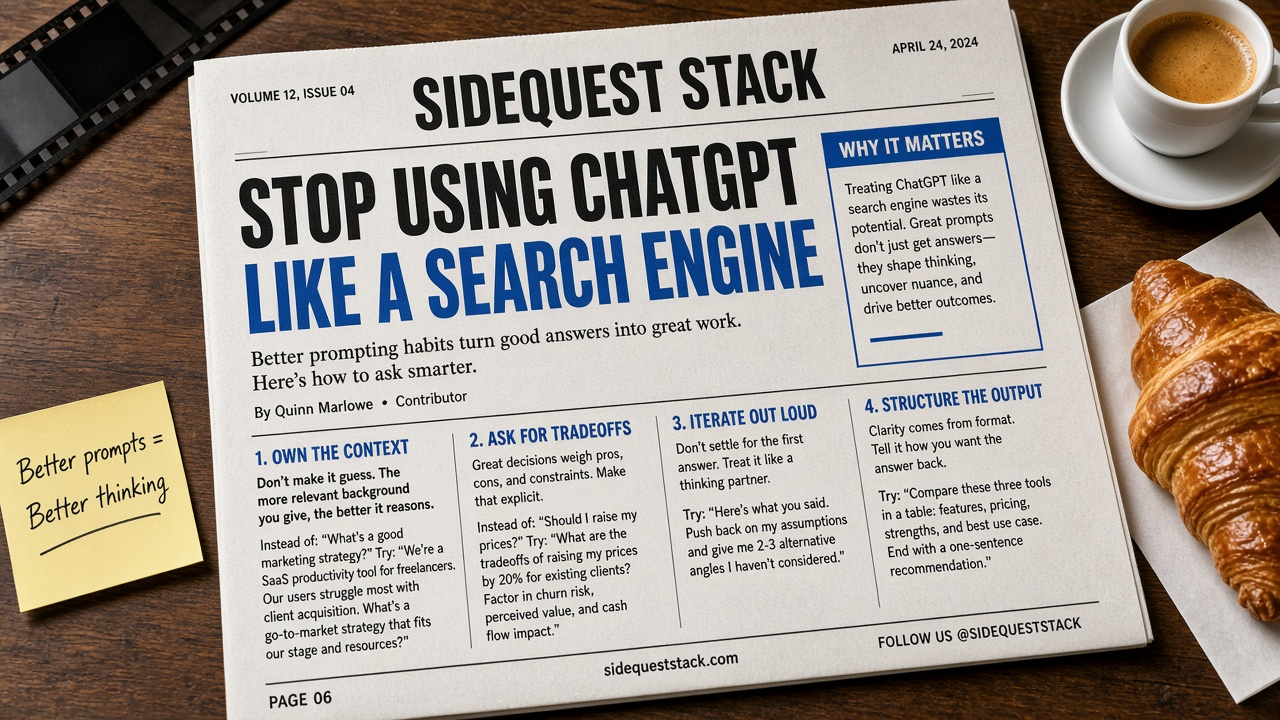
The graphic gives a simple example. Instead of asking, "What's a good marketing strategy?", add the real situation:
We're a SaaS productivity tool for freelancers. Our users struggle most with client acquisition. What's a go-to-market strategy that fits our stage and resources?
That prompt gives ChatGPT something to reason with. It narrows the audience, the product, the pain point, and the decision frame.
You don't need to write a novel. You do need to stop making the tool guess the most important part of the question.
2. Ask for tradeoffs
A lot of weak AI answers feel too confident because the prompt only asks for one answer.
Real decisions usually have tradeoffs. A choice can be good for revenue and risky for retention. It can save time while reducing quality control. It can make a workflow faster while making it harder to explain later.
If you want better thinking, ask for the tension directly.
Instead of asking, "Should I raise my prices?", try:
What are the tradeoffs of raising my prices by 20% for existing clients? Factor in churn risk, perceived value, and cash flow impact.
That version asks for judgment, not just permission. It names the change, the affected group, and the criteria that matter.
This is especially useful for business, content, money, hiring, automation, and tool decisions. Ask ChatGPT to compare the upside, downside, risk, timing, and second-order effects before you act.
Good prompts don't just say, "What should I do?"
They say, "Help me understand what I would be choosing, and what I might be giving up."
3. Iterate out loud
The first answer is usually a starting point, not the final answer.
This is where people leave a lot of value on the table. They ask one question, skim the response, copy a few lines, and move on. That can work for a quick definition. It's not how you get sharper strategy or cleaner creative work.
Use the response as the next input.
You can say:
Here's what you said. Push back on my assumptions and give me 2 to 3 alternative angles I haven't considered.
That kind of follow-up turns ChatGPT into a working conversation. It asks the model to critique the frame, not just decorate it.
Other useful follow-ups:
- What would make this plan fail?
- What assumption am I making that may not be true?
- Give me the simpler version.
- Give me the version for a beginner.
- Give me the version for someone with a tiny budget.
- What would you ask me before finalizing this?
- Rewrite this with more practical examples and less fluff.
The goal isn't to keep prompting forever. The goal is to make the thinking visible enough that you can judge it.
4. Structure the output
Sometimes the answer isn't the problem. The shape of the answer is.
A long block of text may be hard to compare, scan, edit, or turn into action. If you already know how you need to use the information, say so.
Ask for the format you want:
- A table
- A checklist
- A step-by-step plan
- A decision tree
- A short brief
- A script
- A comparison grid
- A one-page summary
- A first draft with headings
The graphic gives a practical version:
Compare these three tools in a table: features, pricing, strengths, and best use case. End with a one-sentence recommendation.
That prompt does two important things. It defines the columns, and it defines the final decision output.
Format isn't decoration. Format is part of the work. A good structure makes the answer easier to review, reuse, and improve.
A better prompt formula
If you are stuck, use this basic shape:
I am trying to [goal]. The context is [background]. The main constraints are [constraints]. I care most about [criteria]. Give me [format]. Include tradeoffs, risks, and any assumptions I should check.
Here is a working example:
I am trying to plan one month of Pinterest content for a small affiliate site. The context is that I publish practical AI workflow articles for creators and side hustlers. The main constraints are limited time, no paid ad budget, and no repeated topics. I care most about useful evergreen clicks, clear titles, and honest disclosures. Give me a 10-idea content plan in a table. Include tradeoffs, risks, and any assumptions I should check.
That prompt is longer than "give me Pinterest ideas."
It's also much more likely to produce something usable.
What to include when the stakes are higher
For low-stakes brainstorming, a quick prompt is fine.
For anything that affects money, public claims, client work, health, legal choices, hiring, privacy, or publication, slow down and add a review layer.
Include:
- The source material you want it to use
- The facts it shouldn't invent
- The claims that need verification
- The audience's level of knowledge
- The tone you want
- The decision you are trying to make
- The final format you need
Then check the result yourself. ChatGPT can help reason, draft, organize, and pressure-test. It shouldn't become the final authority for current facts, private decisions, or claims you publish under your name.
Five prompt upgrades you can use today
Use these when a prompt feels too thin:
- Add the audience: "Write this for a solo creator who is new to affiliate marketing."
- Add the constraint: "Assume I only have two hours a week."
- Add the decision criteria: "Prioritize low cost, easy maintenance, and privacy."
- Add the format: "Return this as a checklist with no more than eight steps."
- Add the critique: "Tell me what is weak, risky, or missing before giving the final version."
None of these are magic phrases. They work because they give the model a job, a frame, and a standard for the answer.
The habit that makes ChatGPT more useful
The best prompt habit isn't memorizing templates.
It's pausing long enough to ask: "What would a smart person need to know before helping me?"
Give ChatGPT that information. Ask it to show the tradeoffs. Respond to its first draft. Tell it the shape you need.
That's how you move from quick answers to better thinking.
Search-style prompts can still help when you need a definition or a starting point. But when the work matters, don't just ask for an answer.
Build the conversation that gets you to a better one.